
Mission
Simulation
Flight and aerospace, ship bridge and conning, ground vehicle and crew, JTAC, tower and spatial disorientation training, mission rehearsal and after-action review — inside a world that is geometrically correct rather than approximated.
Why the geometry is the enabling condition
A crew is looking at a world, and either that world is geometrically correct or it is not. Ours is correct at the design eyepoint: no pre-warping, no edge blending, no seams, no facets, and uniform resolution everywhere the eye lands. That argument makes itself to anybody who has run a projection dome or a panel array.
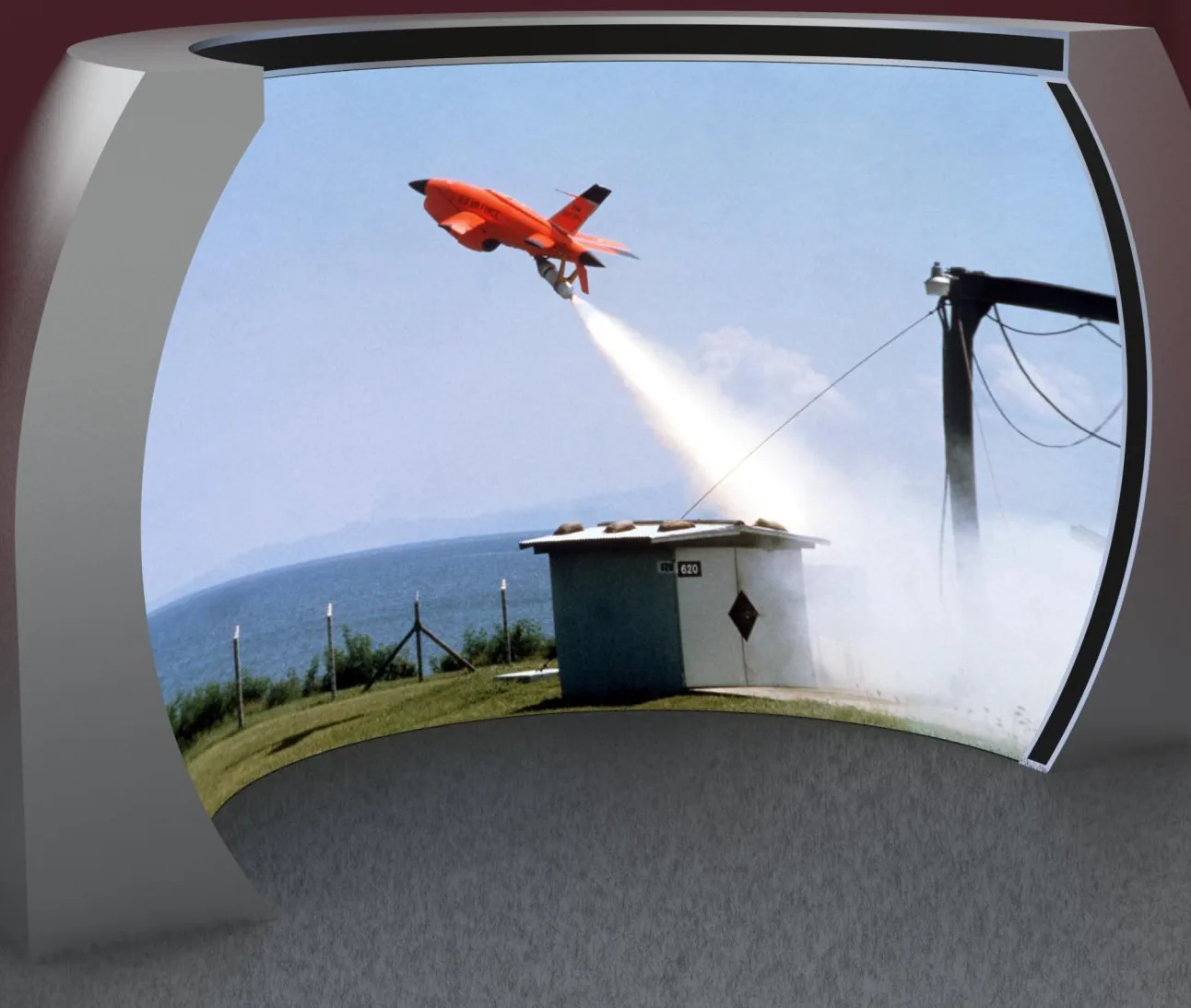
What follows are three questions, and they are worth asking before a requirement is written. Is the training improved by showing the whole field rather than a forty-degree cone? How much does angular accuracy matter to the trainee — do they aim, steer, judge closure, call a bearing, clear a corner? And how much does a shared view matter: open eyes, their own hands and kit in sight, teammates read as people rather than as avatars, real consoles and mockups standing inside the volume. We build to whichever of those a program actually needs.
Where this applies
- Flight and aerospace simulation — horizon at the equator, correct peripheral motion cues, look-up and look-down.
- Ship bridge and conning — a continuous undistorted horizon, with the bridge mockup and its crew inside the volume.
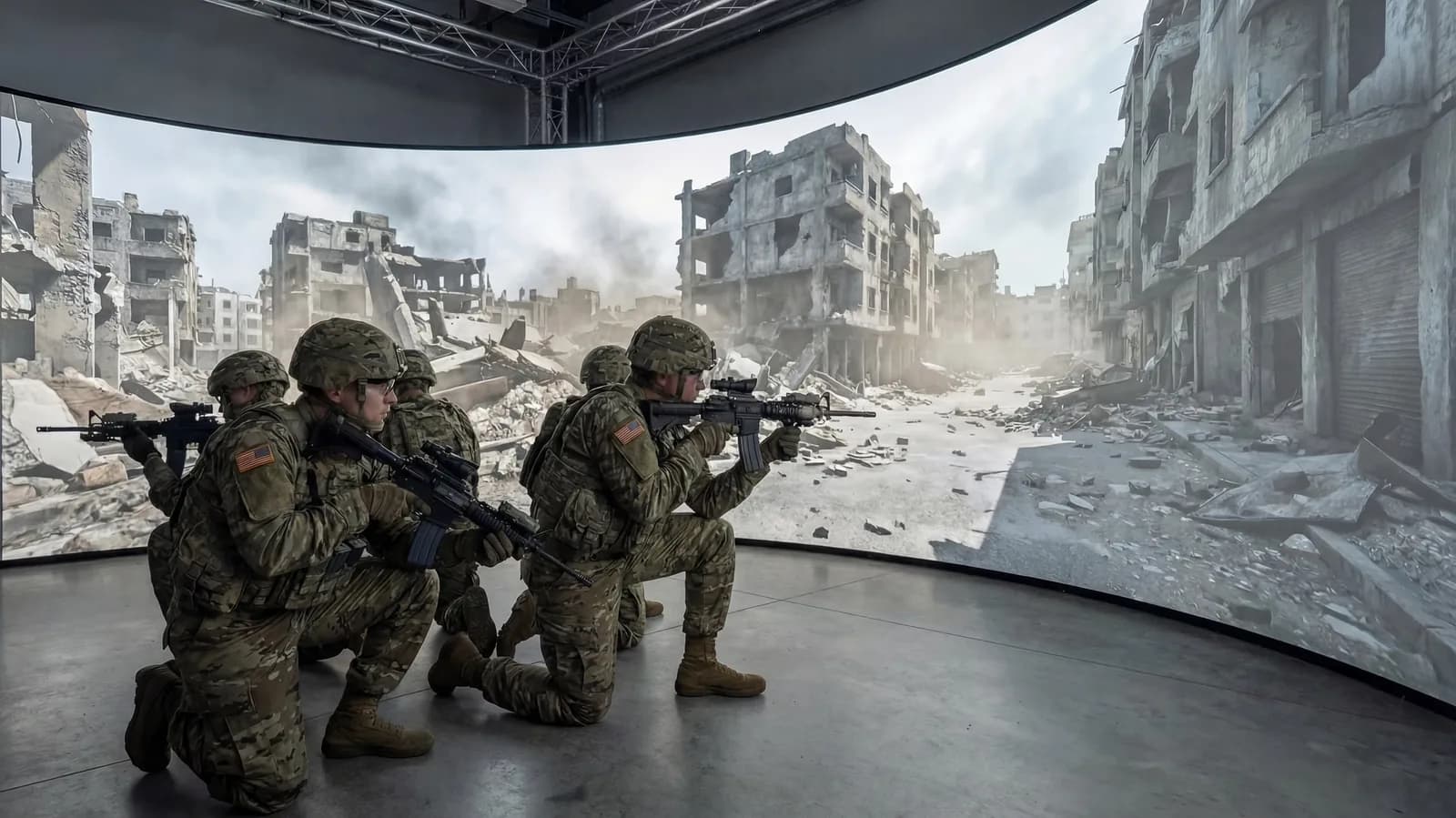
- Ground vehicle and crew simulation — correct angular size of distant objects, terrain undulation, crew co-presence.
- Counter-UAS and overhead threat presentation — most of what we build faces forward, so coverage above and behind is a configuration decision rather than something every fixture includes. Tell us if the threat picture needs it and we will scope for it.
- JTAC and forward air control — wide-field out-the-window visuals against an accredited standard; talk-on requires correct angular bearing.
- Air traffic control tower simulation — a continuous panoramic horizon, sustained wide-field scanning, and look-down specified as a viewshed rather than an angle.
- Spatial disorientation and vestibular training — the undistorted horizon is the instrument.
- Space operations — docking, rendezvous, EVA, surface work and satellite repositioning, where all-sky content is natively egocentric.
- Mission planning, rehearsal and after-action review — teams stand inside a reconstruction of the operating environment, with annotations legible at equal distance.
- Maintenance and walk-around training — full-scale, walkable, open-eye, and for more than one trainee at a time.
What we need to know to help you
Tell us as much of this as you know — even roughly. Say you have a room this size and twelve people to train at once. We can answer with a configuration rather than a brochure.
- What the training has to achieve, and who is being trained — one crew, twelve people at once, a class that rotates through.
- The space you have or could have. Rough dimensions and ceiling height are enough to start, along with anything fixed in the middle of it.
- How much of the horizon the task uses, and whether anything genuinely happens overhead.
- Which image generator the program carries, and whether it can render to a spherical surface at the correct eyepoint.
- What you run today, and what it costs to keep it certified.