
Mission
Combat-Ready Awareness and Operations
In-platform rather than in-facility. A virtual portal around the crew position, including above and behind, and remote operation of uncrewed and remote systems for individuals or teams.
Why the geometry is the enabling condition
An armored vehicle troop compartment has no windows. A surround display puts a virtual portal around the troop position, so a squad has tactical awareness of what is outside before they exit into it. Overhead and rear threat presentation is a genuine capability no forward-facing screen can match — a specific requirement rather than a common one, and where it applies it decides the purchase.
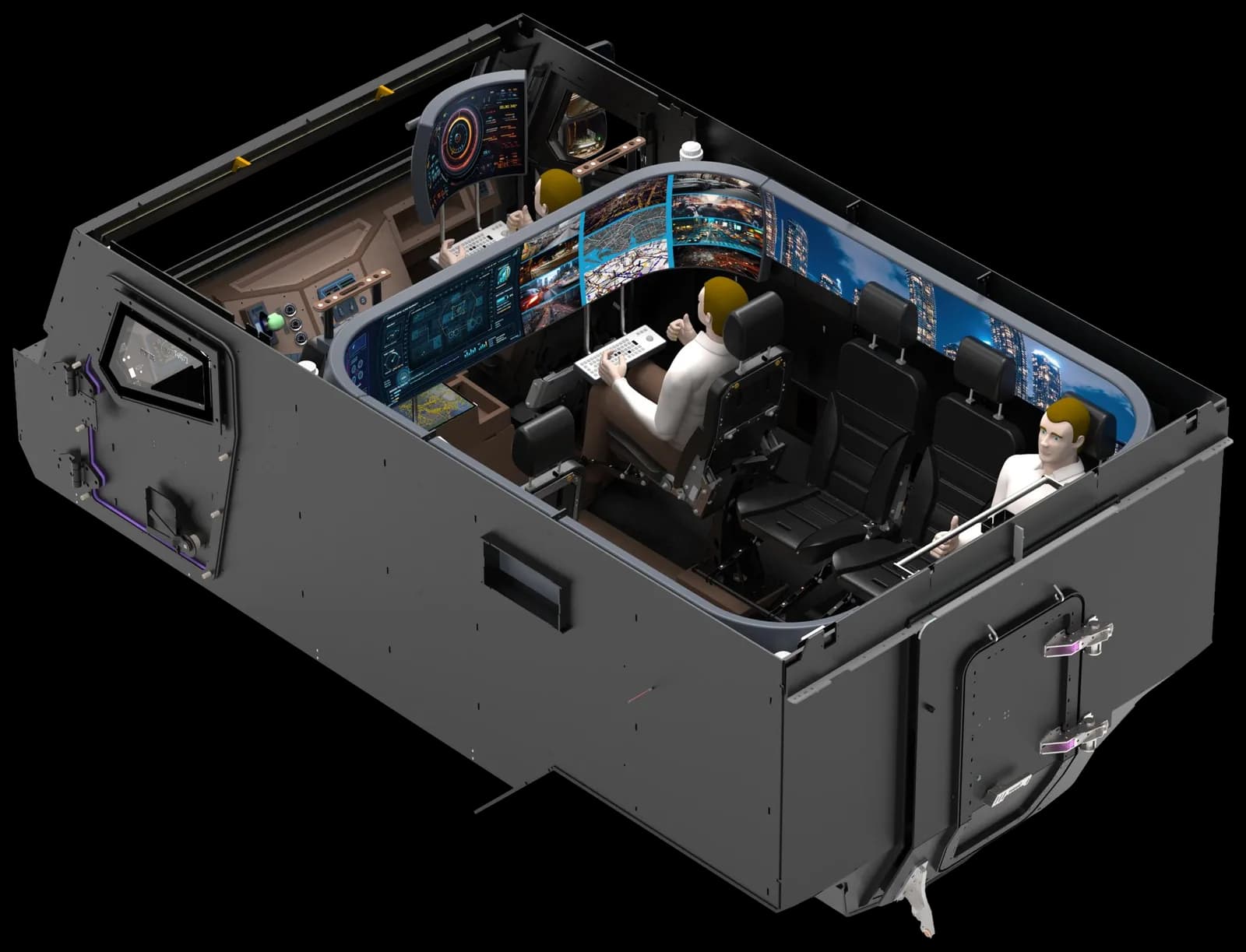
The same geometry serves the operator who is not in the platform at all. A spherical or wide-field camera feed maps onto a surface of matching curvature without heavy warping, which removes the mental remapping a multi-monitor wall imposes on anyone flying, driving or handling something at a distance. Where the sensor's native output is already panoramic — a photonics mast, a camera ring — the display presents it rather than flattening it.
Where this applies
- Crewed platforms without windows — a virtual portal around the troop or crew position, including above and behind.
- Teleoperation — UAS, UGV, robotics and EOD.
- Submarine photonics mast and periscope operations — a native 360° panoramic strip, presented rather than flattened.
- Underwater, ROV and submersible piloting.
- Air traffic control — the operational virtual and remote tower, replacing a faceted ring of flat panels with a continuous horizon.
- Remote facility, critical infrastructure and border monitoring.
What we need to know to help you
Tell us as much of this as you know — even roughly. Say you have a platform of this type and a crew of six who need to see out of it. We can answer with a configuration rather than a brochure.
- Any operational objectives or constraints you can describe — what the crew or operator has to be able to do, and what the platform or the mission will not allow.
- Whether overhead and rear presentation is part of your threat picture.
- The platform power, envelope and shock constraints.
- Where the pixels come from — a synthetic scene, or live cameras that have to be stitched.
- Whether this is closed-loop control, and what latency it needs.